Norway's Right is Obsessed With Immigration and Crime

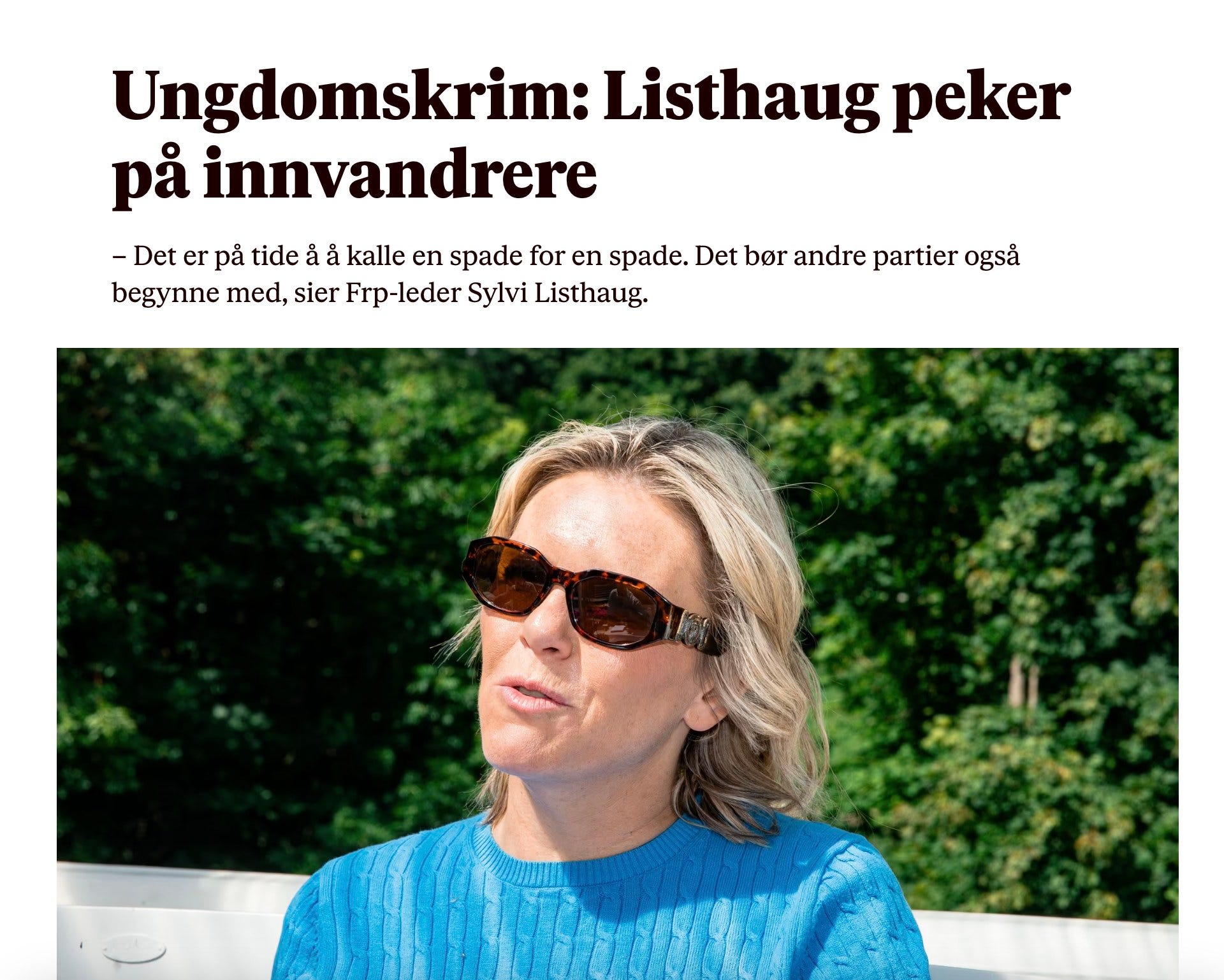
Norway is a safe, prosperous, and diverse society. So why can't the right stop talking about immigration and crime?

Blogs

It’s election season in Norway. On September 8, voters will likely choose between a red-green coalition—including the Labour Party, Socialist Left Party, Red Party, Green Party, and Centre Party—or a right-wing bloc, potentially led by the ethnonationalist-neoliberal Progress Party, currently polling second behind Labour, and joined by the Conservative Party, Christian Democratic Party, and Liberal Party.

With less than two weeks to go, some polling indicates the red-green bloc may secure a majority in the Storting. But it remains a tight race. August polling averages, for instance, show the red-green coalition with 85 mandates, a narrow majority, against the right-wing bloc’s 84 mandates.

Continue reading

Between MAGA and a Hard Place

Two books — one on Steve Bannon and the global far right, the other on life at a Chinese university — reveal a world increasingly riven by ideological contestation. Fukuyama's "end of history" is most definitely over.

Blogs

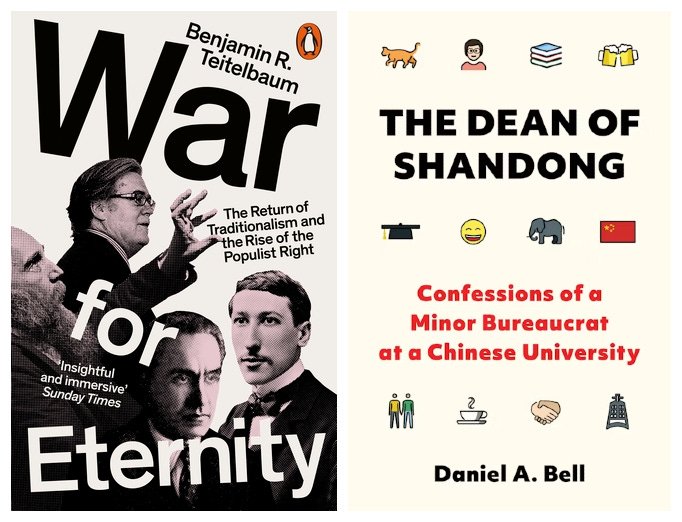
Benjamin R. Teitelbaum (2020). War for Eternity: The Return of Traditionalism and the Rise of the Populist Right. Penguin Books.

Daniel A. Bell (2023). The Dean of Shandong: Confessions of a Minor Bureaucrat at a Chinese University. Princeton University Press.

Published half a decade ago now, War for Eternity examines the rise of the new right, including the alt-right or “populist nationalist” movement, via key figures like Steve Bannon, Aleksandr Dugin, and a smattering of other far-right characters from across the globe. Sadly, the book remains even more relevant now, five years later, under Trump 2.0.

Continue reading

The Great American Decoupling

Under Trump 2.0, the U.S. is decoupling from the world—and the world from it. Both are worse off for it.

Blogs

The philosopher Hegel once described observing Napoleon riding out from the town of Jena after battling the Prussian army. On horseback, Napoleon, “this world-soul,” in Hegel’s words, was a “wonderful sensation to see.” The conquering French statesman seemed to embody history itself, an overwhelming force “concentrated here at a single point, astride a horse,” who, Hegel wrote, “reaches out over the world and masters it.”

When Trump strode out onto the stage in the Rose Garden—soon reportedly to be paved over, like in a Joni Mitchell song— to announce his “Liberation Day” tariffs on April 2nd, he, too, seemed to embody the zeitgeist of an age: resentful, nationalistic, ludicrous, willing to apply punitive measures against everything from penguin-inhabited islands to the world’s second-biggest economy. This was indeed a (perverse) “world-soul” appearing before a stunned global audience. Concentrated in a single point, the empirical person of Donald J. Trump wielded a terrifying, Napoleonic power, channeled through what may have been an LLM-generated, but at any rate deeply irrational, formula, aimed at taking a wrecking ball to the world economy.

Continue reading

What’s the Matter with Kentucky?

Are Trumpists found—or created? A ground-level report from eastern Kentucky by the renowned sociologist Arlie Hochschild only tells half the story of how Trump’s MAGA base came into being.

Blogs

Arlie Russell Hochschild (2024). Stolen Pride: Loss, Shame, and the Rise of the Right. The New Press.

Why do people continue to vote for Trump?

Arlie Hochschild is an eminent Berkeley sociologist with half a century’s worth of experience, having invented key concepts like “emotional labor” in a 1983 study of service work, The Managed Heart, and the notion of a “second shift”—the domestic labor that is (still) disproportionately performed by women. More recently, Hochschild has published a 2016 study of the Tea Party movement, Strangers in Their Own Land: Anger and Mourning on the American Right, based on observations and interviews in Louisiana.

Continue reading

The AI Hype Bubble

And its cognitive, social, and financial risks.

Blogs

The promise of Artificial (General) Intelligence is the greatest hype bubble this side of the new millennium.

Huge checks are being cashed on the promise of AI’s profitability. The chip manufacturer Nvidia currently has a market cap of 3 trillion dollars, making it the second-most valuable company in the world. Its bloated valuation stems in large part from the ongoing AI revolution, which has sent demand for graphics-processing chips like those made by Nvidia soaring. Meanwhile, OpenAI, the maker of ChatGPT, was valued at an astonishing $340 billion in early 2025. And there’s little sign that investments in the technology are letting up. Four tech titans—Meta, Alphabet, Amazon, and Microsoft—plan on pouring more than $300 billion into AI in 2025 alone. Clearly, there’s lots of loose capital floating around for those willing and able to get aboard the AI hype train.

Continue reading

The Courts and the Street

Judges can serve as critical bulwarks against an authoritarian turn. But in the end, only grassroots organizing and a mass popular movement can truly withstand authoritarianism.

Blogs

In mid-March, Trump surprised his political opponents by rejecting a series of last-minute presidential pardons signed by his predecessor Joe Biden, including those, in Trump’s menacing language, offered to “the Unselect Committee of Political Thugs, and many others.”

Posting on Truth Social, Trump declared that Biden’s pardons were “VOID, VACANT, AND OF NO FURTHER FORCE OF EFFECT.” As his presidency drew to a close, Biden offered a series of pardons, starting on December 1st with his son, Hunter Biden, and ending in a last-minute series of clemencies on January 19th, including Anthony Fauci, General Mark Miller, members of Congress serving on the Select Committee investigating the January 6 Attack, as well as members of Biden’s immediate family.

Continue reading

Technofeudalism and Telecoms

Taking a closer look at two books — Yanis Varoufakis's 'Technofeudalism' and Eva Dou's 'House of Huawei' — reveals the deep entanglement of technology and politics.

Blogs

Yanis Varoufakis (2023), Technofeudalism: What Killed Capitalism. Vintage.

Eva Dou (2025), House of Huawei: Inside the Secret World of China’s Most Powerful Company. Portfolio.

Yanis Varoufakis’s much-touted Technofeudalism: What Killed Capitalism is essentially built atop hyperbole: Varoufakis subscribes to the peculiar thesis that “capitalism is now dead.” By this he means that “its dynamics no longer govern our economies”—and while that takes some unpacking, in essence Varoufakis appears to believe that capitalism has now been “replaced by something fundamentally different”: the titular technofeudalism.

Continue reading

The Specter of Inflation

The far right has weaponized the idea of inflation. We should critically examine how nationalist movements activate and manipulate ideas about economic hardship for political gain.

Blogs

One frequently invoked explanation among progressives for the resurgence of far-right politics in recent times is inflation: Prices rise, food and energy costs go up, mortgages become more expensive, wages don’t keep up, and, so the story goes, as a consequence, working- and middle-class voters begin casting about for a scapegoat to blame for their economic woes. In short, economic pain pushes ordinary people into the arms of the radical right.

Continue reading

Fluid Fascism

Blogs

Trump’s chosen ideology is what we might termfluid fascism, a remarkably flexible and adaptive ideological approach that cuts across the political spectrum and familiar divides, allowing the two-term president to engage inpolicy liquefaction: oozing from right to left and back again, fluid fascism...

Continue reading

The Blitzkrieg President

Blogs

We’re in the fourth week of the second Trump administration, and as many commentators have noted there is simply so much going on in U.S. politics—and therefore global politics: What happens on 1600 Pennsylvania Avenue in large measure shapes the world.

Continue reading