Covering the Field of Power: Lionel Barber’s Financial Times Diaries

Blogs

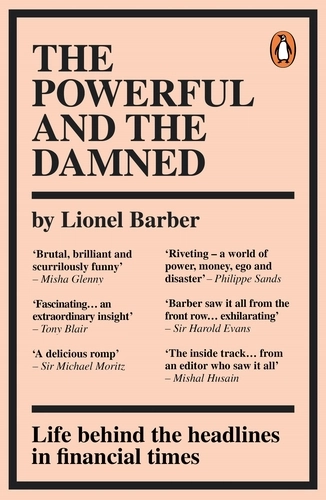
Lionel Barber (2020). The Powerful and the Damned. London: WH Allen.

If one wants to understand power today, one could do a lot worse than reading former Financial Times editor Lionel Barber’s memoir-esque book, The Powerful and the Damned (2020). Sociologists like to think they understand power, but it is all too liable to be a power in the abstract; Barber, though writing polished prose in the retroactive style of a “diary” (he admits in the preface that he was not in the habit of keeping a diary during his 15 years’ tenure as FT editor, so the book is a backdated construction of sorts), produces a tantalizing glimpse into the personal relations and institutional fabric that undergird what we might term, following Bourdieu, the transnational field of power, a web of interconnected organizations, groups, and individuals who make up the upper echelons of financial, political, media, and even ecclesial power around the world. (Churchmen make their appearance several times throughout the book, often in unflattering proximity to the heavy-handed wielders of temporal power.) Though perhaps unsurprising to savvy social observers, Barber shows how power finally relies upon dense webs of personal relationships, constituted in the last instance by the interaction of flesh-and-blood individuals who mobilize money and words (or economic capital and symbolic power) to promote an agenda that they are not always in control nor even conscious of. And these webs of relations both enable and ensnare the operators of power, posing particular risks to journalists, who are always at risk of becoming caught up in the heady social games of the powerful, thereby forgetting their mission: the ceaseless, remorseless critique of power in the service of reducing social domination. All too often, however, Barber’s memoirs reveal how the media becomes a willing participant in relations of domination, not merely a bystander to but a willing participant in and party to the field of power, entranced by its interior privileges, spellbound by the gifts of the dominant, sometimes material, but often wholly symbolic (a gesture, a sign of deferral at the right time, a flattering invitation or visit, a sense of “belonging” to the club of the wealthy and esteemed).


Continue reading

The Hinterland of Social Democracy: On the Conceptual Limits of Nordic Welfare Capitalism

Every instantiation of decommodifying welfare capitalism relies on a hinterland, an exterior space or world for which commodification remains the rule whose function is to service the interiority of social-democratic welfarism.

Blogs

[Full-text, final PDF version available here.]

ABSTRACT: Every instantiation of decommodifying welfare capitalism relies on a hinterland, an exterior space or world for which commodification remains the rule whose function is to service the interiority of social-democratic welfarism. Taking Norway as its case study, this article unfolds the notion of a protective “cupola,” following Žižek, and a “centaur state,” following Wacquant, as the preeminent political-economic innovations of late-modern social democracy. While extracting resources, cheap labor, goods, and financial profits from the global hinterland, the welfare-capitalist state privileges its national citizenry, and, despite significant neoliberal transformation, continues to protect the populace from the discomfiting effects and vagaries of the market, albeit at the expense of the world beyond its bounds. Social democracy, then, hinges on the preservation of difference, and fails to offer a truly global, universal solution to the commodifying effects of market capitalism.

Continue reading

Notes on Evolutionary Game Design

The paradox of computer games is that the best of them offer a kind of limitless freedom to the player, but one which is, of course, tightly regulated by way of a predesigned architecture: all elements of subjective freedom have in fact been—in almost authoritarian, heavy-handed...

Continue reading

Orson Welles, Postmodernist

Blogs

F For Fake (1973). Director: Orson Welles. Runtime: 1h 35m. [Youtube]

It is extraordinarily difficult to know what to make of Orson Welles’s F For Fake (1973), which constantly threatens to splinter, to shatter in on itself, much like the famous mirror scene in his much earlier effort, The Lady From Shanghai (1947), cutting hither and thither, never allowing the viewer to rest in anything resembling epistemic certainty. Here is Welles’s foray into the genre of the mockumentary, avant la lettre, which he must be said to have invented with Fake. It may also be considered, as some critics have postulated, an essay film (some claim Welles said so himself, though this is probably apocryphal, fittingly for a film about the uncertainty of knowing). But to place it in this category presupposes that, as in an essay, there is a clear thesis being advanced. The key to understanding the late, mature Welles, however, is to recognize his absolute lack of self-seriousness, seeming to exclude anything quite so ponderous as an argument or thesis.

Continue reading

Memories of Bob Hargrave (1949-2012), philosopher

Blogs

From what I’ve been able to gather, Robert Mark Hargrave—his full name, so foreign to me—spent decades teaching philosophy at Oxford’s esteemed Balliol College, a cloistered environment of the British power elite that produced at once some of that country’s worst minds (Boris Johnson went there in the 1980s) and its finest (Adam Smith, Aldous Huxley; John Wycliffe was Master of Balliol way back in the 1360s; more recently, J. L. Austin, Harold Macmillan, Roy Bhaskar, Richard Dawkins…).

Continue reading

Michel Foucault’s Library of Inscription Copies

What books were on Foucault’s bookshelves?

Blogs

What books were on Foucault’s bookshelves? Thanks to the Beinecke Collection at Yale University, we can now access 1,440 records of books “from the library of Michel Foucault” Importantly, these are not all the books Foucault ever owned—they’re a subset of his library, consisting of books inscribed by their respective authors and gifted to Foucault. The Yale librarians have labeled it the “Michel Foucault Library of Inscription Copies.” It necessarily, then, skews heavily toward thinkers and writers contemporaneous with Foucault, who had some affinity for Foucault, and who for a variety of reasons wanted him to own a signed copy of their latest work.

Continue reading

The Death of the Well-Printed Book

Blogs

Every book I seem to pick up these days is poorly printed. By this I mean that the ink is decidedly weak. As a result, the book is difficult to read with ease and pleasure. The lettering is almost never a strong, striking black, but invariably a sort of washed-out grey, the weak ink already fading into mere nothingness, straining the eyes and heightening one’s sense of the ephemerality of all Being, the futility of all knowledge…This is surely, on the whole, a disservice to the republic of readers. My Penguin edition of John Barton’s A History of the Bible (2019), besides betraying the terrible glue binding so characteristic of latter-day Penguins—which will probably dissolve within a decade—is not so much printed on the page as it is facsimiled: there is a kind of indistinct, digital-type, semi-pixellated placement of the whole page in blurry grayscale, rather than the stamping-out of individual letters in sharp, dark, inky typeface. Similarly, my hardcover copy of a P. G. Wodehouse novel from the Everyman’s Library series is washed-out and obscure. Black letters are never black any longer, it would seem, but so many shades of gray. Even though the binding is rugged and cover sturdy, the actual printed page is disappointingly weak. Everyman’s and Penguin produced quite decent books in the previous century, but no longer, apparently.

Continue reading

Some Scattered Remarks on John Barton's (2020) 'A History of the Bible'

A review of John Barton's (2020) A History of the Bible (Penguin).

Blogs

John Barton (2020). A History of the Bible. London: Penguin.

With friends like John Barton, who needs the New Atheists?

The most effective opponents of Christian spirituality today are not its overt detractors but its academic analysts, who don’t so much deny God as paint all things theological in so much grey in grey, as Hegel might have said. It is above all a sad book, freighted down by the sadness of spiritlessness, effectively diminishing the spiritual core that makes the Christian take on the Bible so attractive in the first place. We care for the Bible not because it is a complex patchwork of sources and genres, but because it vibrates with divine energy. Buried beneath a morass of textual criticism, whither belief in the risen Christ? Where is the sense of Immanuel, “God with us,” that has drawn and continues to draw millions into a christocentric existence?

Continue reading

Capitalism and Outer Space: Replies to an Interlocutor

A Q&A on outer space sociology. (By Victor L. Shammas and Tomas B. Holen)

Blogs

How did you decide to write about this topic?

In our paper “One giant leap for capitalistkind: Private enterprise in outer space,” we were interested in trying to understand what the sudden explosion of interest and investments in outer space meant, structurally and theoretically, with regard to contemporary capitalism. One significant event for us was the much-publicized launch of SpaceX’s first Falcon Heavy rocket in February 2018. It represented a combination of new technological advances in rocket design and space technology, the ascendancy of the private enterprise model of space exploration, and a neoliberal ideology in response to the question of humans as space-traveling beings.

Continue reading